01
AI & Machine Learning
Models built for a specific job, evaluated against your data, and shipped where they can be monitored.
Evaluation runsvs baseline
Our modelBaseline
Vision systems, LLM applications, and the platforms that put them in front of users. Built by one team, from the data pipeline through to the interface someone actually uses.
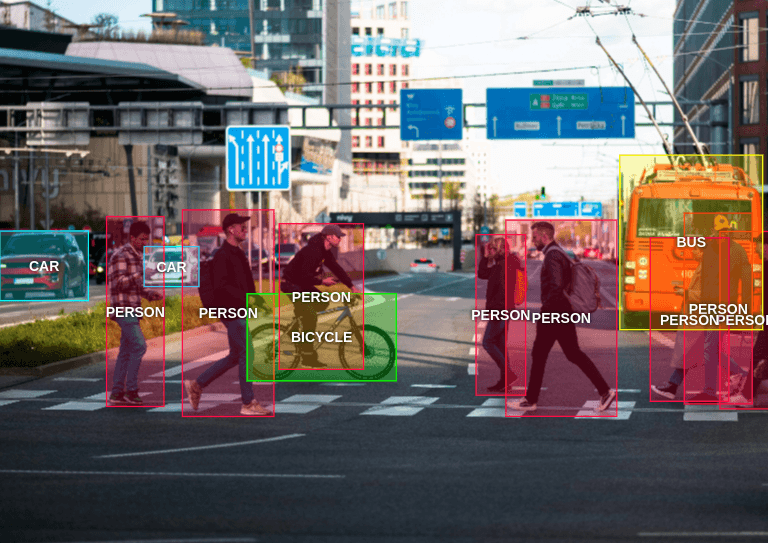
Detection, segmentation and tracking trained on your imagery, then packaged to run against real cameras and real throughput targets.
The tools we build with, day to day
Building AI systems since day one
One office, in person
Since 2021
Across four continents
Running since 2023
The whole stack
Teams usually arrive with the middle layer solved and the other four missing. The notebook works; there is no pipeline feeding it, no service wrapping it, no interface using it, and no way to tell when it starts drifting.
We build all five, because a gap in any one of them is what stops a model reaching production.
Ingestion, validation, labelling, and the lineage to prove it
Training, evaluation against a real baseline, calibration
Versioned inference API, latency budgets, a rollback path
The interface where a person acts on the output
Drift monitoring, cost tracking, a retraining runbook
What you get
A web platform, a mobile app, a data pipeline or a model. The definition of finished does not change, and neither does what you end up owning.
Release gates
A change that fails any gate does not reach production.
Selected work
Dedicated teams owning a complete development stack, agents running operational work, and engagements that have held for years.
What we do
Most AI projects need a model, a data pipeline, and an application. Splitting those across vendors is where timelines go. We do all three.
Models built for a specific job, evaluated against your data, and shipped where they can be monitored.
LLM features that hold up outside a demo - grounded in your content, measured, and cost-bounded.
The platforms, APIs, and infrastructure that turn a model into something a customer can use.
Deploys
On merge
Environments
In code
Pipelines and labelled datasets. The part most teams underestimate, and the reason models underperform.
Schema checks at the boundary, agreement measured before volume.
Plus 8 annotation and labelling services
How we work
None of this is exotic. It is the discipline that separates a model that demos well from one that is still running a year later.
Every model ships with a test set and a documented baseline. If we cannot measure whether a change helped, we do not claim it did.
The people training the model also build the application around it. No handoff, no translation layer, no arguing about whose bug it is.
We will tell you when a problem does not need machine learning, and when your data is not ready for the model you want.
Confidence gets calibrated and low-confidence output goes to a reviewer. Automating the easy 90% beats guessing on the hard 10%.
Reproducible pipelines, written runbooks, and documentation aimed at your engineers. You should not need us to keep it running.
Our longest engagement has run since 2023, with a dedicated team of 30 on that account. We optimise for the second year, not the first invoice.
How an engagement runs
The feasibility work happens in the first two weeks, before anyone has committed a quarter to it. If the answer is no, you find out while it is still inexpensive.
You describe the problem and show us the data. We tell you what looks feasible, what does not, and what we would need to find out first.
We look at what you actually have - volume, labels, quality, gaps - and establish a baseline. This is where most surprises surface, which is why it comes early.
A working prototype trained or built on your real inputs, with measured results against the baseline. You get a number, not a demo.
The production system: pipelines, service, application, tests, and infrastructure. Deployed to staging early and reviewed with you every two weeks.
Runbooks, documentation, and a walkthrough for your engineers. Or we stay on and keep running it - which is what most clients choose.
Client testimonials
We have worked with AnnotateHub for close to 3 years now. They handle all our image and video annotations, as well as computer vision consulting. They are an exceptional provider. They have excellent communication and understanding of our issues. They are both proactive and responsive. They have shown an impressive ability to ramp up resources for us on short notice and they have high standards for quality control. More than a supplier, they have been a strong partner and a part of our success.

Arthur Goujon
Founder & CTO, Sorted Tech

AnnotateHub has proven to be an outstanding partner in computer vision projects, delivering innovative solutions with unmatched expertise. Their services, including facial recognition, object detection, and scene analysis, have significantly enhanced our workflows. Their attention to detail and commitment to delivering high-precision labeling have consistently exceeded our expectations.

Assam
Co-founder, MiniAi Live
Blogs
15, Jan 2024
17, Feb 2024
12, March 2024
Questions
If yours is not here, ask us directly - we answer scoping questions before any commercial conversation.
Start here
The first two weeks are a feasibility review, not a sales process. You get a written assessment and an honest read on what's achievable with the data you have.